Government contracts routinely go through 5, 10, or 20+ amendments over their lifecycle. Each one changes something: rates, scope, personnel, terms. When the current state of a contract exists only as the sum of its modifications, verifying an invoice becomes an exercise in document archaeology.
The Amendment Problem
A government contract begins as a document with clear terms. Over the course of its lifecycle - which may span 5 to 10 years for large IT services or construction contracts - those terms change. Rate schedules are updated to reflect annual escalation clauses. Scope is added or removed through task orders and modifications. Key personnel requirements shift. Payment terms are renegotiated.
Each change is captured in a formal contract modification. A large services contract may accumulate 10 to 25 modifications over its lifetime. The current state of the contract is the sum of the base agreement plus all modifications, applied in order, with later modifications superseding earlier ones where they conflict.
Here is where the problem begins: most contract management systems store modifications as separate documents. Determining the current authorized rate for a specific labor category requires reading the base contract, then checking each modification in sequence to see whether any of them changed that rate. For a contract with 15 modifications, this is a 30-minute task per rate category - assuming the modifications are well-organized and clearly written, which they often aren't.
Real-World Impact
Consider a concrete example from our analysis. A state IT services contract was awarded in 2019 with a rate schedule covering 12 labor categories. Over the next five years, seven amendments modified various rates - some increasing rates per an annual escalation clause, others adjusting rates when labor categories were reclassified.
By 2024, the vendor was billing at rates established in Amendment 5 for three categories, Amendment 7 for two categories, and the original base rates (which were never modified) for the remaining seven. A reviewer checking an invoice against just the most recent amendment would miss that some categories were still governed by the base contract.
This is not a hypothetical. Auditors in multiple states have flagged exactly this scenario: vendors billing at rates from superseded amendments, and agencies paying without catching the discrepancy because the rate looked close enough to be plausible.
Why Current Processes Fall Short
The fundamental challenge is that contract modifications are legal documents, not data updates. When Amendment 7 says "Section 4.2 of Amendment 3 is hereby revised to read as follows," the new rate exists only in the text of that amendment. There is no automatic update to a master rate table. The next person reviewing an invoice must know that Amendment 7 exists, that it modified a specific rate, and that it superseded the rate in Amendment 3 (not the base contract, and not Amendment 5).
Most agencies maintain a contract file - physical or electronic - containing all modifications. But "the documents are all there" is not the same as "the current terms are readily determinable." The former requires a trained person to spend time reconstructing the latter every time a question arises.
Automated Rate Resolution
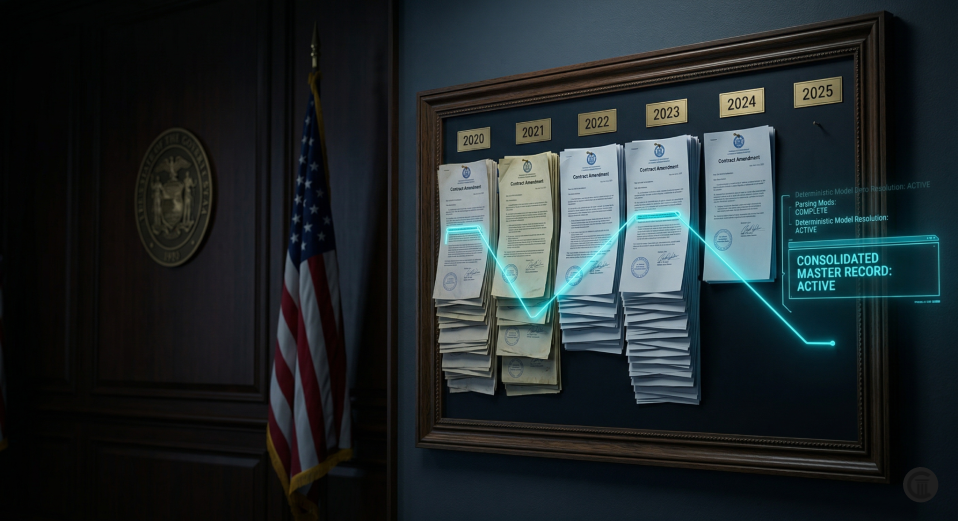
The solution is to treat each contract as a living data model that is updated whenever a modification is processed. The base contract establishes the initial data model - rate schedule, authorized scope, key personnel, payment terms. Each modification is parsed to determine exactly which elements it changes, and the model is updated accordingly.
When an invoice arrives, the system can immediately compare each line item against the current-state rate schedule without requiring any human document archaeology. The comparison is deterministic: either the rate matches or it doesn't, and if it doesn't, the system can show exactly which document established the current authorized rate.
This approach requires investment upfront - someone (or something) must parse each modification and translate its legal language into structured data updates. But the return on that investment is realized on every subsequent invoice for the life of the contract. For a five-year contract with monthly invoicing, a one-time parsing effort replaces 60 instances of manual rate verification.
The Broader Pattern
Contract modification tracking is a microcosm of the broader post-award oversight challenge. The information needed to verify compliance exists, but it's locked inside documents rather than available as structured, queryable data. The officer tasked with verification must perform document research before they can begin the actual analysis.
Technology that bridges this gap - extracting structured terms from legal documents and maintaining a current-state model of each contract - doesn't replace human judgment. It eliminates the document archaeology that currently consumes 60-0% of the time spent on invoice review, freeing officers to focus on the judgment calls that actually require their expertise.
For agencies evaluating contract management systems, the critical question isn't whether the system stores modifications (they all do). It's whether the system can resolve the current state of any contract term across all modifications without requiring manual reconstruction. That capability is the difference between a document repository and a compliance tool.